
Saxony's joint prison with Thuringia will be much more expensive:
The prison isn't finished yet, but the cost has almost doubled compared to the original plan ...
saechsische.de/sachsen/sachsens-gemeinsames-gefaengnis-mit-thueringen-wird-teurer-5628568.html


Similar to This
Previous


Extremely high occupancy: Saxony wants more trains between Leipzig and Thuringia: Auf dem Bahnhof in Saalfeld stehen eine Regionalbahn von Abellio und der ...
otz.de/lokales/saalfeld-rudolstadt/article413789989/extrem-hohe-auslastung-sachsen-moechten-mehr-zuege-zwischen-leipzig-und-thueringen.html


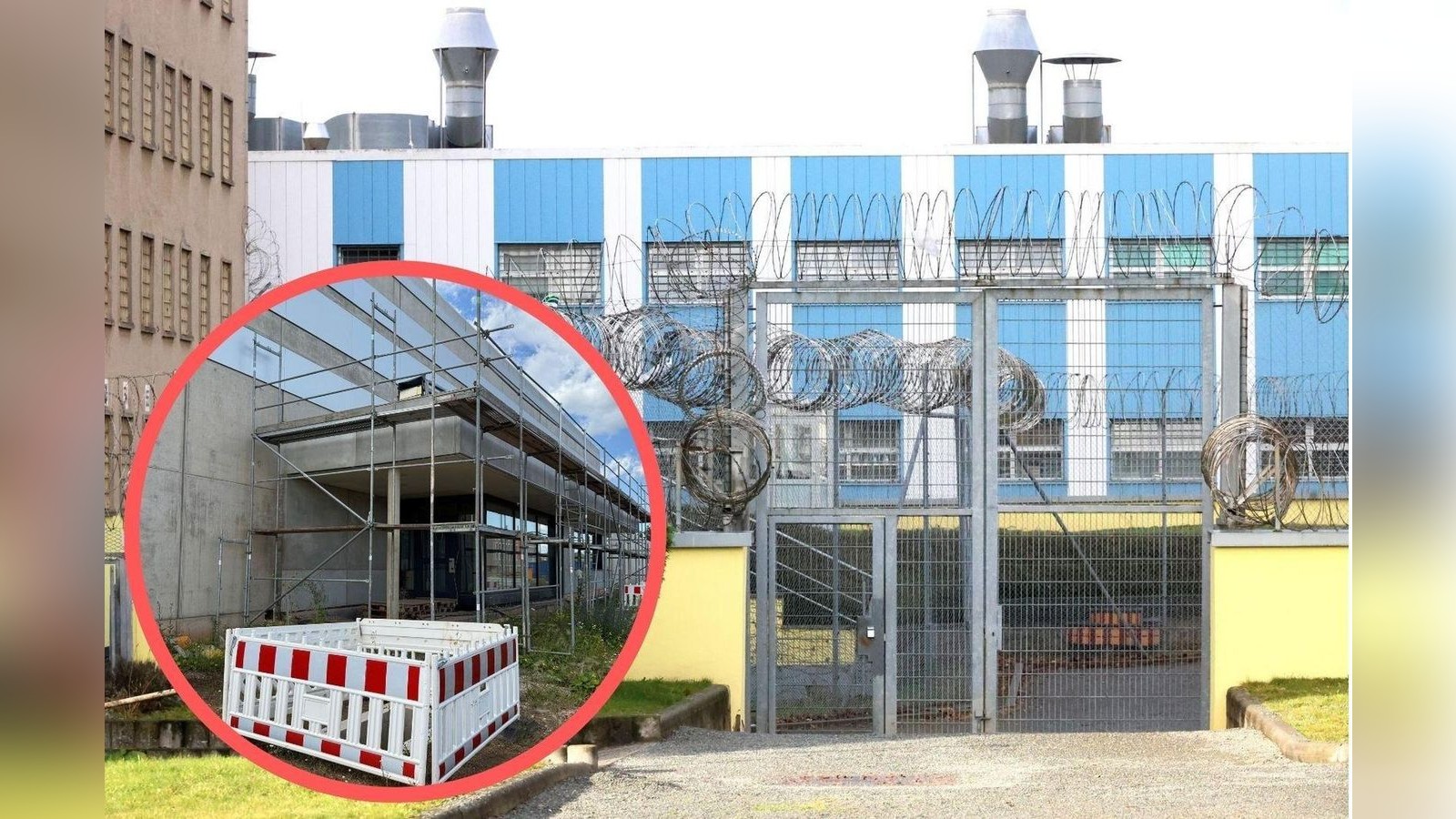


 Subscription required Zwickau, a money pit: Thuringia considers its own prison: The aging Hohenleuben Prison is to be replaced by the two-state prison in the future.
thueringer-allgemeine.de/politik/article408953432/millionengrab-zwickau-thueringen-denkt-ueber-eigenes-gefaengnis-nach.html


"Strong nerves, your CL": Message from Lindner reveals FDP's exit calculation: With the exception of Wolfgang Kubicki, the Liberals have been conspicuously ...
focus.de/politik/stichtag-22-september-starke-nerven-euer-cl-interne-nachricht-von-lindner-offenbart-exit-kalkuel-der-fdp_id_260276678.html


AfD battle plan after the state elections in Thuringia and Saxony: The AfD has gained new power and opportunities in Thuringia and Saxony. This is how it will ...
t-online.de/nachrichten/tagesanbruch/id_100480966/afd-schlachtplan-nach-der-landtagswahl-in-thueringen-und-sachsen.html

Elections in Saxony and Thuringia: Was that the end of the traffic lights?: The traffic light parties together only received around 14 percent in the election in ...
zdf.de/nachrichten/politik/deutschland/wahl-sachsen-thueringen-spd-gruene-fdp-ampel-100.html
Key FactsTraffic Light Coalition Faces Pressure After Election Losses
Sep 2, 2024 · Reading time: ~30 sec.
Summary created with AI assistance · Source: zdf.de
- The traffic light coalition parties achieve only about 14 percent in Saxony and around 10 percent in Thuringia, significantly impacting the political landscape in Berlin.
- Political scientist Karl-Rudolf Korte highlights this historic poor performance, while AfD leader Alice Weidel refers to it as a 'requiem for the traffic light coalition.'
- SPD Secretary Kevin Kühnert announces a stronger emancipation of the SPD following the elections, amid ongoing internal disputes among coalition partners.
- FDP politician Wolfgang Kubicki states that the coalition has lost its legitimacy, raising the possibility of new elections, although Korte does not expect a coalition breakup.

 Subscription required Name of BSW and Wagenknecht: There must be no unelected party leaders: A party names itself after the person at the top: this has never happened before ...
faz.net/aktuell/feuilleton/debatten/name-des-bsw-und-wagenknecht-es-darf-keine-nichtgewaehlten-parteifuehrer-geben-19958682.html
Key FactsWagenknecht Alliance Disrupts German Political Landscape
Sep 3, 2024 · Reading time: ~30 sec.
Summary created with AI assistance · Source: theguardian.com
- The Sahra Wagenknecht Alliance (BSW) has emerged as a significant player in German politics, achieving 16% and 12% in elections in Thuringia and Saxony, respectively, within just eight months.
- While ruling out formal coalitions with the far-right AfD, the BSW's strong position makes it a potential kingmaker in future negotiations.
- Sahra Wagenknecht highlighted that the BSW's voter support reflects widespread dissatisfaction in Germany and positions the party as a force for change.
- The BSW combines left and right policies, criticizing the government's energy strategy and advocating for a more diplomatic approach to foreign relations.


 Limited free access Thuringia election 2024: All results of the state election in Thuringia - | live: Which coalitions are possible in the Erfurt state parliament? Which parties and ...
zeit.de/politik/deutschland/2024-09/thueringen-wahl-2024-landtagswahl-wahlergebnisse-live

 Subscription required Reactions to the election in the east: Hohenlohe Bundestag members Ebner, Leiser and Abel are in favor of continuing the traffic light coalition
swp.de/lokales/schwaebisch-hall/hohenloher-bundestagsabgeordnete-nach-wahldebakel-im-osten-ebner-leiser-und-abel-sind-fuer-fortsetzung-der-ampel-koalition-77494026.html


Expert on BSW: "Wagenknecht wants to be Vladimira Putina": Ilko-Sascha Kowalczuk is considered an expert on East Germany and warns of a national crisis ahead of ...
zdf.de/nachrichten/politik/wagenknecht-bsw-kowalczuk-ostdeutschland-afd-putin-100.html
Key FactsWagenknecht and BSW's Rise in East Germany
Aug 21, 2024 · Reading time: ~30 sec.
Summary created with AI assistance · Source: zdf.de
- Historian Ilko-Sascha Kowalczuk discusses Sahra Wagenknecht's fascination with authoritarian state models, such as those represented by Vladimir Putin. The Bündnis Sahra Wagenknecht (BSW) promises a strong, authoritarian state, which resonates in East Germany due to its historical ties to paternalistic governance.
- Kowalczuk emphasizes that the freedom and democracy achieved in 1989 were not supported by the majority of East Germans but rather by an active minority. This discrepancy between the active and passive roles of the populace has resulted in many East Germans not learning to engage in democratic processes.
- Wagenknecht's positions, particularly her opposition to arms supplies to Ukraine and her alignment with Russia, reflect a political conviction aimed at fostering close economic and political ties with Russia. Kowalczuk interprets this as a desire for a security architecture between Germany and Russia.
- The political landscape in Saxony and Thuringia may lead to a coalition between BSW and CDU, which Kowalczuk finds morally questionable. He warns that the upcoming state elections could result in a political crisis rather than stable governance.


Saxony election could mean a debacle for the traffic light parties: According to a survey, the SPD, Greens and FDP could miss out on a place in parliament in the ...
fr.de/politik/sachsen-wahl-koennte-debakel-fuer-ampel-parteien-bedeuten-zr-93248117.html
AfD successes in the East? Göring-Eckardt worried about the judiciary: If the AfD becomes the strongest force in the East, Katrin Göring-Eckardt fears for the ...
zdf.de/nachrichten/politik/deutschland/goering-eckardt-justiz-afd-landtagswahl-thueringen-brandenburg-sachsen-100.html

Radio license fee: CDU votes in Thuringia with red-red-green for an increase: In Thuringia, the members of the state parliament have approved an increase in ...
welt.de/politik/deutschland/article222801664/Rundfunkbeitrag-CDU-stimmt-in-Thueringen-mit-Rot-Rot-Gruen-fuer-Erhoehung.html
Next