
Story Details
| Last Updated | |
| Total Articles | 1 |


Similar to This
Previous

Nature Nov 19
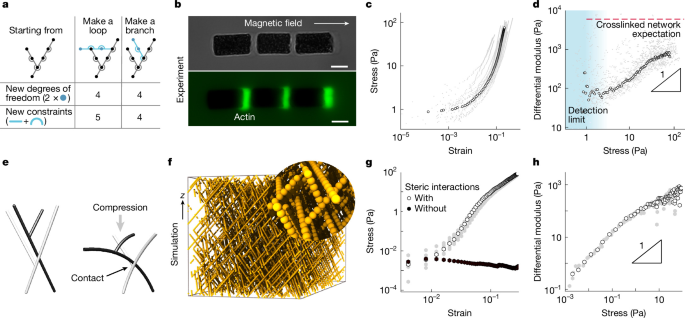
Transient contacts between filaments impart its elasticity to branched actin: Cells dynamically assemble actin into branched networks to push on their ...
nature.com/articles/s41586-026-11300-1


Self-propelled actin filaments may explain how cells change shape spontaneously: Cells can spontaneously change shape even without external signals ...
phys.org/news/2026-06-propelled-actin-filaments-cells-spontaneously.html

How eggs get built: Cells use actin and microtubules as a coordinated scaffold: A Northwestern Medicine study has shed light on one of the most intricate ...
phys.org/news/2026-02-eggs-built-cells-actin-microtubules.html

How actin wavefronts rescue T cell receptors from endocytosis: Every time our body encounters a new disease-causing agent, a crucial defense system called ...
phys.org/news/2026-01-actin-wavefronts-cell-receptors-endocytosis.html

The mechanical ratchet: A new mechanism of cell division: Cell division is an essential process for all life on Earth, yet the exact mechanisms by which cells ...
phys.org/news/2026-01-mechanical-ratchet-mechanism-cell-division.html

Nanomotors drive protein network formation inside artificial cells: No one has yet created a fully functioning artificial cell. But a research team at Aarhus ...
phys.org/news/2025-12-nanomotors-protein-network-formation-artificial.html

New Atlas Dec 13 25

We can now watch influenza enter human cells: A revolutionary ViViD-AFM super microscope provides unprecedented real time insights into influenza virus entry ...
newatlas.com/infectious-diseases/how-influenza-enters-human-cells/

How cancer cells keep their chromosomes intact to continue dividing relentlessly: Scientists at Children's Medical Research Institute (CMRI) have made a ...
phys.org/news/2025-12-cancer-cells-chromosomes-intact-relentlessly.html
New Atlas Aug 03 25

Physically squeezing cancer cells gives them a blast of power: Discover how squeezing cancer cells boosts their survival and offers new insights into potential ...
newatlas.com/cancer/squeezing-cancer-cells/


Scientists finally know how cells build a structure that lets them migrate: Some of the body's cells stay put for life, while others are free to roam. To move ...
phys.org/news/2025-01-scientists-cells-migrate.html

Water gives cells a push in blood vessel formation: Water flow plays a surprising role in the formation of new blood vessels as zebrafish develop ...
phys.org/news/2025-01-cells-blood-vessel-formation.html

Uncovering new regulatory mechanisms in embryo implantation: Implantation is the initial step in pregnancy, where the embryo attaches to and enters the ...
phys.org/news/2024-10-uncovering-regulatory-mechanisms-embryo-implantation.html

'One ring to rule them all': How actin filaments are assembled by formins: Actin is a highly abundant protein that controls the shape and movement of all our ...
phys.org/news/2024-04-actin-filaments-formins.html
Biophysicists reveal how three proteins interact to fine-tune cellular movement: A single human cell teems with as many 100,000 different proteins ...
phys.org/news/2023-07-biophysicists-reveal-proteins-interact-fine-tune.html
An electron microscopy study unravels the mysteries of actin filament polarity: Actin filaments—protein structures critical to living movement from single cells ...
phys.org/news/2023-06-electron-microscopy-unravels-mysteries-actin.html
Toxins force construction of 'roads to nowhere': Toxins released by a type of bacteria that cause diarrheal disease hijack cell processes and force important ...
phys.org/news/2022-11-toxins-roads.html
Next